
Ford currently has at least 20 E85 Escape Plug-In Hybrid Electric Vehicles undergoing fleet testing since December 2007. Here is a photo of one of them:
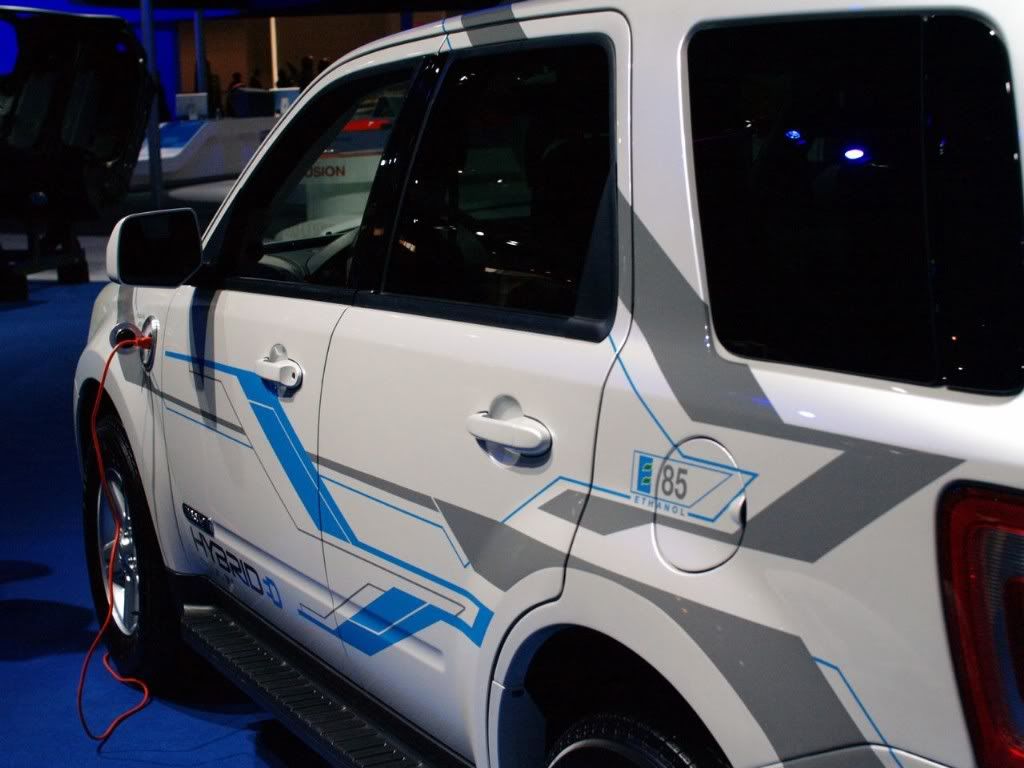
What is different in the E85 Escape Hybrid from mine? Read this: Ethanol also doesn't possess the same energy content or burn rate as gas, which requires the engine to flow more fuel to the injectors to keep performance levels comparable. To handle this increased fuel flow, the Escape Hybrid E85 has a larger fuel pump and larger injectors.
Ford researchers did have to navigate uncharted territory when it came to the Hybrid E85's engine control module (ECM). "An engine that is capable of running on straight gas to E85 has to learn what's in the tank and adjusts accordingly," says Varns.
A vehicle's ECM monitors the exhaust gas sensor and the fuel system's air-fuel ratio, as well as reads the float rod in the fuel tank. When the ECM senses a shift in the engine's air-fuel ratio to the lean side (more air than fuel), it deduces that the vehicle is filled with E85 and adjusts the fuel system accordingly.
"The vehicle learns while the engine is running," says Varns. "But with the hybrid, the engine may be shut off for long periods of time while the vehicle runs on electric power, so we had to make some custom software and calibration changes within the ECM to make sure it could seamlessly remember or relearn the correct percent of ethanol after a shutdown."
Ford, like GM, is using software found in the Engine Control Module to determine the fuel composition and to make fine adjustments with fuel deleivery. This software change can be slightly modified for previous years vehicles with minimum cost. There is also mention of a larger fuel pump and injectors. It is unknown if the fuel pressure also varies (increases with higher ethanol percentage) in the vehicle. These hardware changes are also do able with previous year models. It isn't rocket science to make vehicles "more" E85 compatible. If a lot of changes were needed, then how could the companies sell for the same price as the non-FFV?

No comments:
Post a Comment